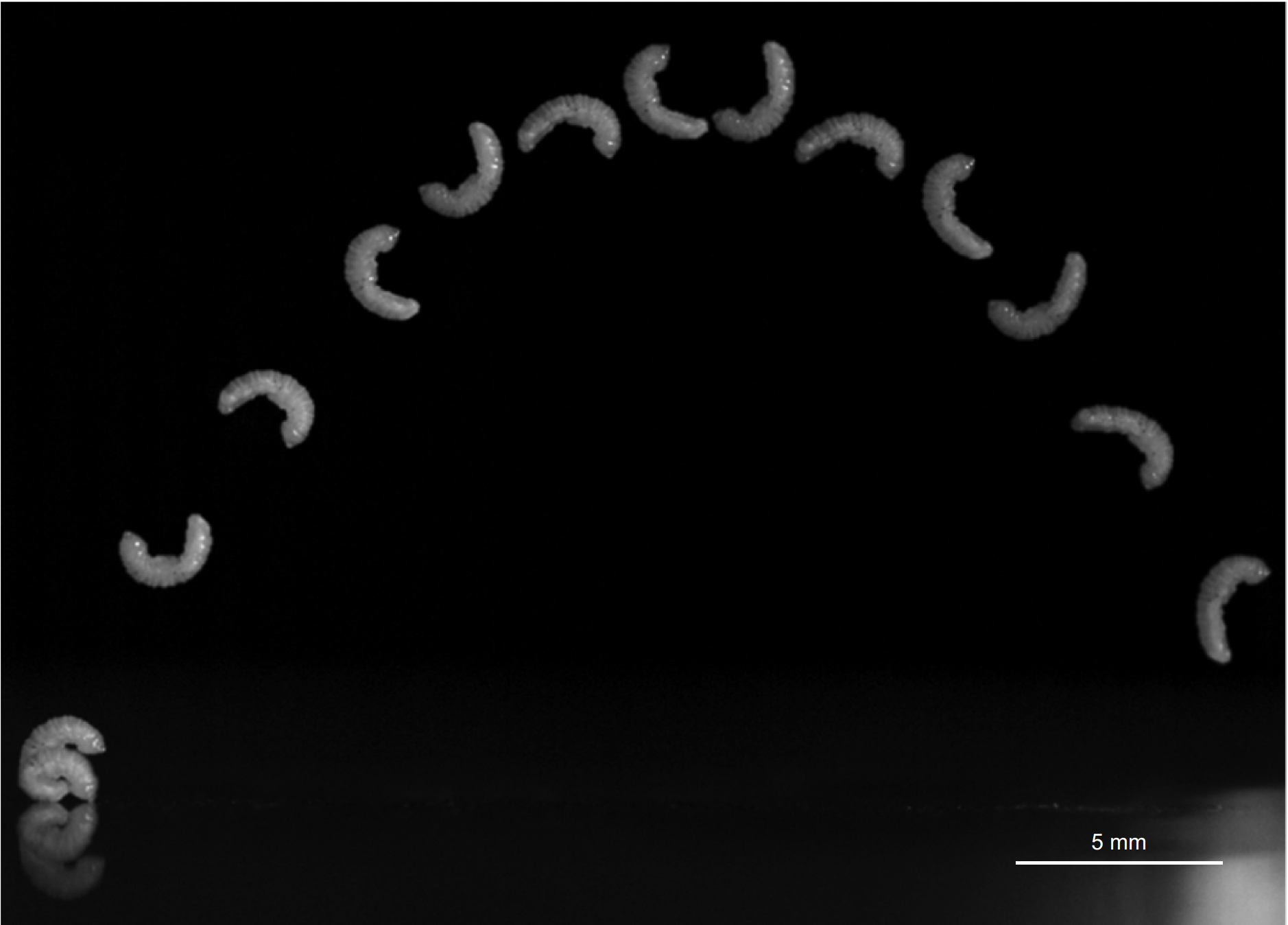
Comparative biomechanics is classically defined as the study of the physics of organisms (not including humans). This field dates back for millennia as scientists and philosophers have pondered how organisms exemplify the rules of physics and how the rules of physics emerge as common designs across the great diversity of organisms. Yet even as the technical abilities to measure and characterize the physics of organisms have accelerated, comparative biomechanics has been slow to adopt the powerful tools of phylogenetics and comparative methods. Meanwhile, the field of engineering biomimetics/bioinspiration (the use of biology to inform engineering design) has expanded rapidly often with minimal incorporation of evolutionary principles and processes. Therefore, a central focus and impact of the Patek Lab is to push forward principled, evolutionary thinking about biomechanics and to use evolutionary biomechanics to more effectively translate biology to engineering design.
The Patek Lab focuses intensively on phylogeny-based analyses of biomechanical systems. Incorporating tools from phylogenetic analyses, geometric morphometrics, systematics, and tests of evolutionary rates, we have established key intersections between the mechanics of systems and their pace and patterns of evolution (Anderson, et al., 2014, Evolution; Anderson, et al., 2016, Evolution & Development; Blanco and Patek, 2014, Evolution; Claverie, et al., 2011, Evolution; Claverie and Patek, 2013, Evolution; McHenry, et al., 2016, J. Exp. Biol.).
For example, across evolutionary diversity, many organisms have evolved the same mechanical output, but through different morphological configurations. This pattern is the crux of a widely-used concept called “many to one mapping” which has been interpreted as a release from limits on morphological change and a catalyst for evolutionary diversification. Mantis shrimp exhibit many to one mapping: across species, their striking appendages exhibit similar mechanical outputs via different configurations of the underlying components. However, mechanical output is highly correlated with only a subset of mechanical components. How can the same dataset simultaneously indicate freedom of evolution through many to one mapping and a tight correlation between those same outputs and a single component? We termed this phenomenon “mechanical sensitivity” in which the output of a system is disproportionately sensitive to change in some of the components. Yet mechanical sensitivity seems to belie the “freedom of evolution” implied by many to one mapping. To resolve this incongruence, we proposed an alternative paradigm in which many to one mapping simply reflects the evolutionary exploration of biomechanically-diverse configurations and that mechanical sensitivity guides evolutionary diversification (Anderson & Patek, 2015, Proc. Roy. Soc. B).
We tested this idea across multiple, independently evolved mechanical systems and discovered that greater mechanical sensitivity is consistently associated with faster rates of morphological evolution (Muñoz et al., 2017, Proc. Roy. Soc. B; Muñoz, et al., 2018, eLife). Therefore, evolutionary change is biased to the traits most tightly correlated with mechanical output. This finding supports a strong influence of mechanical sensitivity on the tempo and mode of evolution. This area of research also addresses the longstanding paradox of constraints in evolutionary biology in which tight mechanical correlations have been argued to either promote or limit evolutionary diversification. Our studies resolve this paradox by demonstrating that strong mechanical relationships are associated with greater rates of evolutionary change.
Evolutionary biomechanics and multidisciplinary research
Through funding by a Multidisciplinary University Research Initiative (MURI), Patek led a multidisciplinary, basic research team of biologists, engineers, mathematicians, polymer scientists, and physicists spanning six universities. We focused on establishing the interdisciplinary principles of fast, small, repeated-use systems. With this brain trust, numbering over 75 participants, we delved into the mechanics of biological systems, built and designed synthetic systems to test mechanical and evolutionary hypotheses, established mathematical and physical models, and explored the diversity of biological systems. We leveraged physical and mathematical models of mantis shrimp and trap-jaw ants to explore the tradeoffs described above and to generate a foundation of evolutionary thinking through which biological systems are not viewed as perfection, but as an informative conglomerate of history, physical tradeoffs, and environments. This interdisciplinary research effort expresses our overarching goals to explore the interface of physics and evolution, ignite basic discovery research in unexplored realms of biology, and launch a robust field of interdisciplinary and translational biomechanics grounded in evolutionary analysis.
For our latest papers on this topic, check out our Google Scholar, Research Gate, or Orcid pages.
